
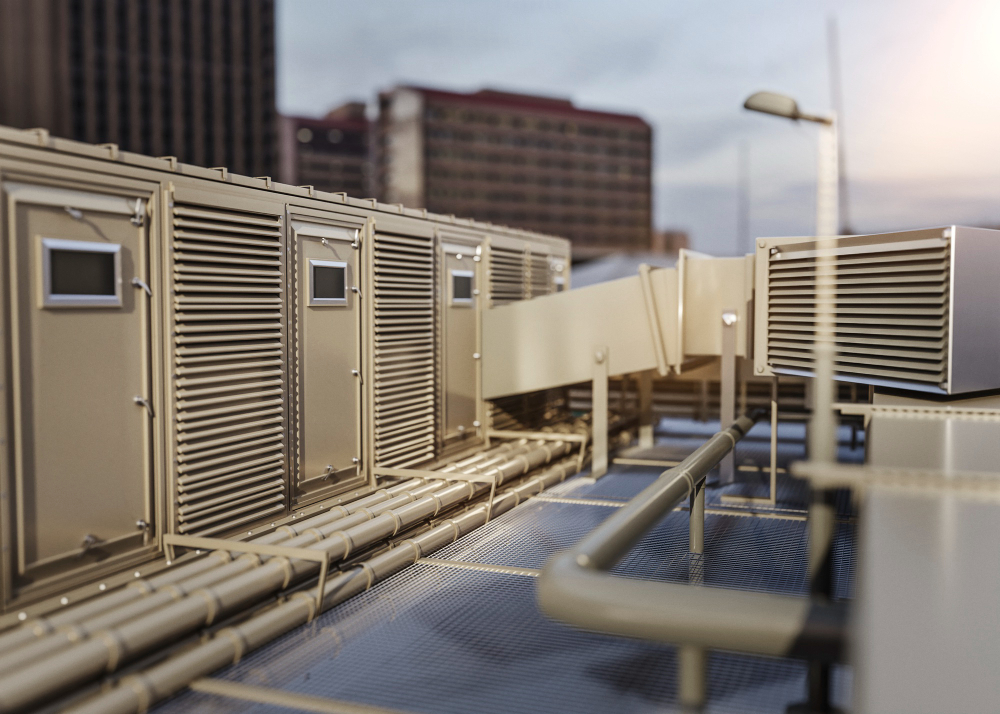
Air handling units (AHUs) are essential for regulating indoor air quality and temperature in spaces such as commercial buildings, hospitals, factories, and large apartment complexes. Understanding an AHU’s functions and selecting the appropriate model for your building can significantly improve energy savings, indoor air quality, and cost-effectiveness.
This guide provides a thorough overview of air handling units, covering their core functions, various models, and answers to common questions.
What is an Air Handling Unit (AHU)?
An air handling unit (AHU) is a sizable metal enclosure equipped with components that manage and move air, forming a key part of HVAC (heating, ventilation, and air conditioning) systems. These units are most often found on building rooftops, in mechanical spaces, or in the basements of industrial and commercial properties.
The main job of an AHU is to treat and circulate air throughout a facility. It draws in fresh outdoor air, filters it, adjusts its temperature by heating or cooling, manages moisture levels, and sends the processed air through ductwork to different areas of the building.
How Does an Air Handling Unit Work?
Understanding how an air handling unit functions enables building managers to make better decisions about maintenance and system efficiency. Below is an outline of the typical operation of an AHU:
Step 1: Air Intake
The process begins with the AHU drawing in fresh outside air through intake vents. Some systems also recirculate a portion of return air from the building to improve energy efficiency. The ratio of fresh air to recirculated air depends on the application and indoor air quality requirements.
Step 2: Air Filtration
Once air enters the unit, it passes through multiple filtration stages. Pre-filters remove larger particles, such as dust and debris, while fine filters capture smaller contaminants, allergens, and microorganisms. In healthcare facilities and clean rooms, HEPA filters may be installed for superior air purification.
Step 3: Temperature Conditioning
After filtration, the air moves through heating or cooling coils, depending on the season and building requirements. During winter, heating coils warm the air using hot water, steam, or electric heating elements. In summer, cooling coils filled with chilled water or refrigerant remove heat, reducing the air temperature.
Step 4: Humidity Control
Modern air handling units include humidification or dehumidification components. Humidifiers add moisture to dry winter air, while dehumidifiers remove excess moisture during humid conditions. Proper humidity control (typically 40-60%) is essential for comfort and preventing mould growth.
Step 5: Air Distribution
Finally, powerful fans or blowers push the conditioned air through a network of ducts to various zones throughout the building. Dampers in the ductwork regulate airflow to different areas, ensuring consistent temperature and air quality throughout the spaces.
Step 6: Return Air
Return air ducts bring air back from occupied spaces to the AHU. Some of this air is exhausted outside, while the rest is mixed with fresh air and recirculated through the system, creating an efficient cycle.
Types of Air Handling Units
Different facilities have varying requirements, which is why multiple types of air handling units are available. Choosing the right type depends on factors such as building size, application, available space, and budget.
1. Draw-Through Air Handling Units
In draw-through AHUs, the fan is positioned after the cooling or heating coils. Air is drawn through the conditioning components before being pushed into the distribution system. This configuration provides better temperature control and is ideal for applications requiring precise air conditioning.
Advantages:
- More uniform air distribution
- Better dehumidification
- Reduced risk of coil freezing
- Suitable for high-humidity environments
2. Blow-Through Air Handling Units
Blow-through units have the fan located before the cooling and heating coils. The fan pushes air through the conditioning components. These units are generally more compact and cost-effective than draw-through models.
Advantages:
- More compact design
- Lower initial cost
- Easier maintenance access
- Suitable for low to medium humidity areas
3. Modular Air Handling Units
Modular AHUs consist of separate modules that can be configured to meet specific requirements. Each module serves a particular function (filtration, heating, cooling, humidification), and they can be arranged in various combinations.
Advantages:
- Highly customizable
- Easy to expand or modify
- Flexible installation options
- Suitable for projects with unique requirements
4. Packaged Air Handling Units
Packaged units come pre-assembled with all components integrated into a single cabinet. These are ready to install and require minimal on-site assembly, making them ideal for quick installations.
Advantages:
- Quick installation
- Factory-tested reliability
- Reduced on-site labor
- Consistent quality control
5. Custom Air Handling Units
For specialised applications such as clean rooms, laboratories, or industrial processes, custom AHUs are designed and built to meet specific requirements for air quality, temperature precision, humidity control, and contamination prevention.
Advantages:
- Tailored to exact specifications
- Meets unique industry standards
- Optimised performance for specific applications
- Can include specialised components
6. Rooftop Air Handling Units
These units are specifically designed for outdoor rooftop installation. They feature weather-resistant construction and are commonly used in commercial buildings where ground-level or indoor space is limited.
Advantages:
- Saves indoor space
- Easy outdoor maintenance access
- No noise transmission to occupied spaces
- Suitable for most commercial applications
Key Components of an Air Handling Unit
A typical air handling unit AHU contains several essential components:
- Casing:The outer enclosure that houses all components, typically made of galvanised steel or aluminium with insulation
- Air Filters:Multiple filtration stages to remove contaminants
- Heating Coils:For warming incoming air during cold seasons
- Cooling Coils:For reducing air temperature and removing heat
- Humidifier/Dehumidifier:Controls moisture levels
- Fans/Blowers:Circulate air through the system and ductwork
- Dampers:Control airflow direction and volume
- Control Panel:Houses sensors, controllers, and automation equipment
- Mixing Chamber:Where fresh and return air are combined
Benefits of Modern Air Handling Units
Investing in a quality air handling unit provides numerous benefits for commercial and industrial facilities:
- Improved Indoor Air Quality:Advanced filtration removes pollutants, allergens, and pathogens
- Energy Efficiency:Modern AHUs with variable speed drives and heat recovery can reduce energy consumption by 30-50%
- Temperature Control:Precise conditioning maintains comfortable environments
- Humidity Management:Prevents mould growth and maintains comfort levels.
- Noise Reduction:Well-designed units operate quietly
- Flexibility:Can be customised for various applications and building sizes
- Compliance:Helps meet building codes and indoor air quality standards
Maintenance Tips for Air Handling Units
Regular maintenance ensures optimal performance and longevity:
- Replace or clean filters every 1-3 months, depending on usage
- Inspect and clean coils annually to maintain efficiency.
- Check fan bearings and belts for wear.
- Verify damper operation and calibration.
- Monitor control systems and sensors.
- Clean drain pans to prevent microbial growth
- Schedule professional inspections twice yearly.
Frequently Asked Questions (FAQ)
1. What is the difference between an air handling unit and an HVAC system?
An air handling unit (AHU) is a component of an HVAC system. While HVAC refers to the entire heating, ventilation, and air conditioning system, including chillers, boilers, pumps, and controls, an AHU specifically handles air distribution and conditioning. Think of the AHU as the “lungs” of the HVAC system.
2. How long does an air handling unit last?
With proper maintenance, a quality air handling unit typically lasts 15-20 years. However, components like filters, belts, and bearings require more frequent replacement. The actual lifespan depends on usage intensity, maintenance quality, operating conditions, and initial build quality.
3. What is the ideal size for an air handling unit?
AHU sizing depends on several factors, including building square footage, ceiling height, occupancy levels, heat load, and climate. An undersized unit won’t adequately condition the space, while an oversized unit wastes energy and creates uncomfortable temperature swings. Professional load calculations in accordance with ASHRAE standards are essential for proper sizing.
4. Can air handling units improve energy efficiency?
Yes, modern air handling units significantly improve energy efficiency through features such as variable-speed drives, heat recovery systems, advanced controls, and economisers. These technologies can reduce energy consumption by 30-50% compared to older constant-volume systems.
5. What maintenance does an air handling unit require?
Regular maintenance includes monthly filter checks and replacements, quarterly visual inspections, semi-annual professional servicing, annual coil cleaning, and continuous monitoring of performance parameters. Preventive maintenance reduces downtime and extends equipment life.
6. Are air handling units noisy?
Modern air handling units are designed for quiet operation, typically producing 50-70 decibels. Proper installation with vibration isolation, acoustic insulation, and appropriate location selection minimises noise transmission to occupied spaces.
7. What is the difference between a draw-through and a blow-through AHU?
In a draw-through AHU, the fan is located after the cooling/heating coils and draws air through them. In a blow-through AHU, the fan is positioned upstream of the coils and pushes air through them. Draw-through units provide better dehumidification and temperature control, while blow-through units are more compact and cost-effective.
8. Can an existing air handling unit be upgraded?
Yes, many components can be upgraded, including filters to higher-efficiency models, standard fans to variable-speed drives, basic controls to smart building automation systems, and adding heat recovery modules. Upgrades can significantly improve performance without complete replacement.
Conclusion
An air handling unit (AHU) is an essential component for maintaining comfortable, healthy indoor environments in commercial and industrial facilities. Understanding how air handling unit AHU systems work, the different types available, and proper maintenance requirements helps facility managers make informed decisions that optimise performance, reduce energy costs, and improve occupant comfort.
Whether you’re planning a new installation or upgrading an existing system, consulting with HVAC professionals ensures you select the right air handling unit for your specific needs. With proper selection, installation, and maintenance, an AHU provides reliable, efficient air conditioning for decades.
For businesses looking to improve indoor air quality, reduce energy costs, or comply with ventilation standards, investing in a modern, well-designed air handling unit is a decision that pays dividends in comfort, health, and operational efficiency.